Kashmir sits closer to Dhaka than most Bangladeshis assume, and a week is enough to fall hard for it. Glide across Dal Lake on a shikara, ride the world's second-highest cable car at Gulmarg, and breathe pine-cooled air in Pahalgam — all on an Indian visa you very likely already have or can easily get. Here is how to plan it sensibly, and what it really costs from Bangladesh.
Why Kashmir, and why a full week
Kashmir is the rare Himalayan destination that feels lavish without demanding a lavish budget. The valley packs together three very different experiences — a lake city, an alpine ski-and-meadow resort, and a riverside pine valley — within a few hours of each other, so a single week gives you genuine variety rather than a rushed checklist.
For Bangladeshis the appeal is doubled by proximity and language. India is right next door, Hindi-Urdu is widely understood, and food leans towards rich, meat-forward Mughlai cooking that feels familiar to a Dhaka palate. Wazwan — the multi-course Kashmiri feast of rogan josh, gushtaba and seekh — alone justifies the trip.
Five days is doable but tight; seven lets you slow down. A sensible rhythm is three nights in Srinagar (with day trips), two in Gulmarg or Pahalgam, and a buffer day for weather and travel friction. Don't try to cram both Gulmarg and Pahalgam as overnight stays AND Sonamarg into one week — pick two of the three to actually sleep in.
Best season: when to go
Spring (roughly late March to May) is the postcard Kashmir most people imagine: the Tulip Garden in Srinagar blooms for a few weeks from late March into April, apple and almond blossom dust the orchards, and the meadows green up. Days are pleasant; mornings and evenings stay cool, so pack layers.
Summer (June–August) is warm, lush and busiest — good for escaping Dhaka's monsoon heat, though prices and crowds peak. Autumn (late September–November) brings chinar leaves turning gold and is, for many, the most beautiful and least hyped window. Winter (December–February) is for snow lovers: Gulmarg becomes a genuine ski resort, but roads can close and Pahalgam access gets harder.
If your priority is tulips and blossom, target the first three weeks of April but accept the bloom is weather-dependent and short. If you want reliable good weather with fewer crowds, aim for the shoulder — May or October.
Getting there from Dhaka
There is no direct Dhaka–Srinagar route, so you connect through an Indian metro — almost always Delhi. The clean option is Dhaka (DAC) to Delhi (DEL), then a domestic hop Delhi to Srinagar (SXR), which takes around 90 minutes. Kolkata is an alternative first stop if fares are better, but Delhi has far more Srinagar flights.
Book the international and domestic legs with enough buffer — at least 3–4 hours in Delhi — because you'll change terminals and re-check bags on most itineraries. A through-ticket on one airline alliance reduces the risk of a missed connection eating your trip.
The overland-then-fly route (Dhaka–Kolkata by air or train, then onward) can save money but costs a day or two. For a one-week trip, fly. Round-trip Dhaka–Srinagar via Delhi typically runs in the ৳45,000–৳80,000 range depending on season and how early you book; shoulder-season fares booked two months out land at the lower end.
The Indian visa, step by step
Bangladeshis need a regular Indian visa — the e-Visa scheme does not cover Bangladeshi passport holders, so you apply through the Indian Visa Application Centre (IVAC). A tourist visa is what you want; apply well in advance because appointment slots and processing can be slow in peak season.
Core documents are your passport (valid 6+ months with blank pages), the completed online form, a recent photo to the exact specification, proof of funds (bank statement), confirmed return flights, and hotel bookings or an itinerary. Get the photo and form right the first time — small errors cause rejections and re-submissions that burn weeks.
Importantly, your visa is endorsed for specific entry/exit points and routes. If you intend to fly straight into Srinagar via Delhi, make sure your port of entry and travel plan are consistent with what's stamped, and keep printed copies of everything. When in doubt, a reputable agency (or Miya Tourism's visa desk) can vet your file before submission.
Srinagar and Dal Lake — the houseboat days
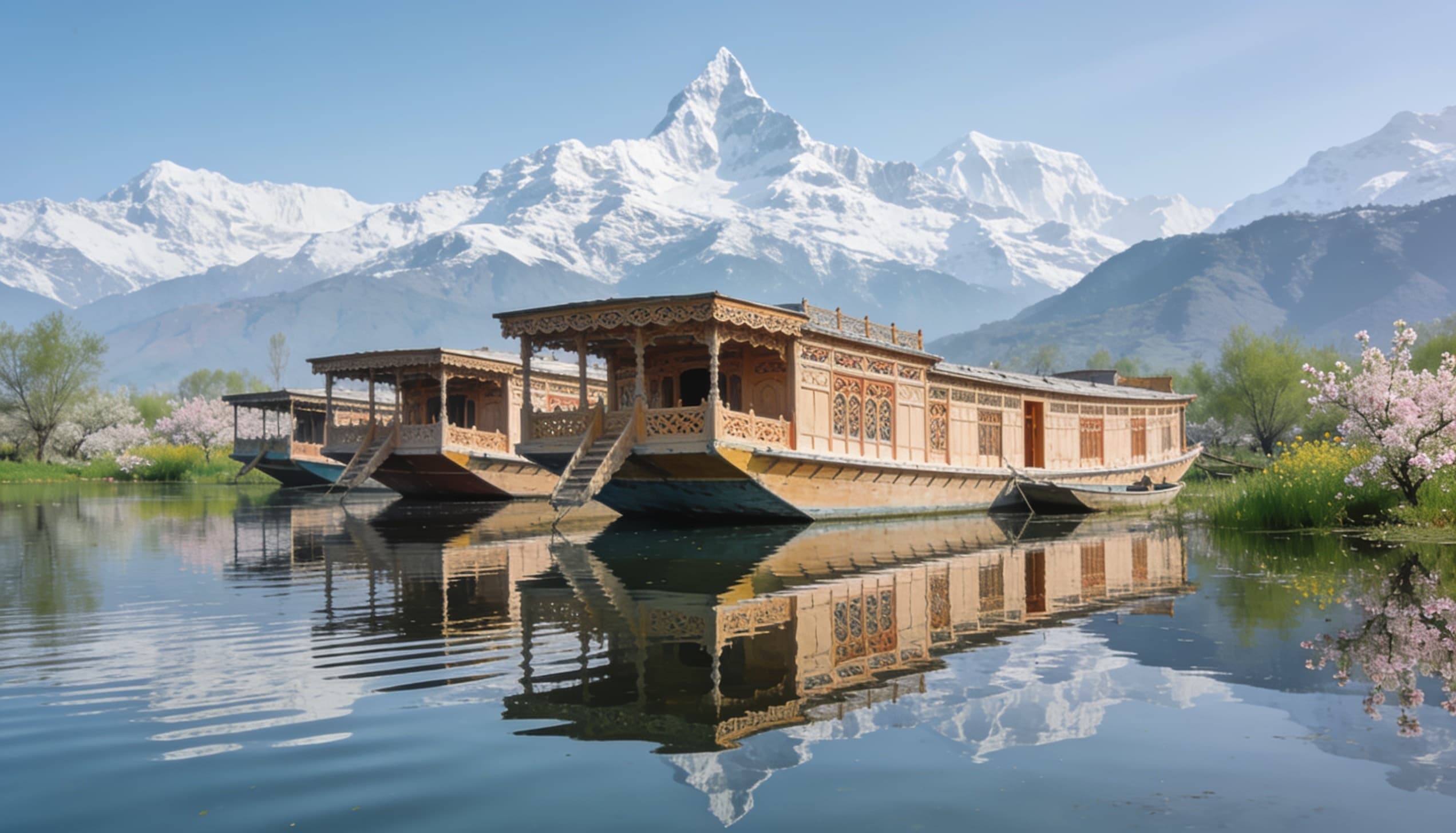
Base yourself first in Srinagar. The signature experience is staying on a houseboat on Dal or Nigeen Lake — carved walnut interiors, breakfast brought by shikara, and the lake waking up around you. Nigeen is quieter and cleaner; Dal is more central and lively. Either way, see the actual boat (or recent photos) before paying, as quality varies wildly.
Spend a slow morning on a shikara ride through the floating gardens and lotus beds, and visit the Mughal gardens — Shalimar Bagh, Nishat Bagh and Chashme Shahi — laid out in terraces against the hills. In tulip season, the Indira Gandhi Memorial Tulip Garden is a must in its short window. Old Srinagar's Jamia Masjid and the bustle of the lakeside markets round out the city.
Eat well here: seek out a proper wazwan if your group is large enough to justify it, and try kahwa, the saffron-and-almond green tea, in the cold evenings. A comfortable houseboat runs roughly ৳3,500–৳8,000 per night including breakfast; mid-range hotels in town can be cheaper.
Gulmarg and the gondola
Gulmarg, about two hours from Srinagar, is the valley's high meadow — green and flower-strewn in spring and summer, deep in snow in winter. The headline is the Gulmarg Gondola, one of the highest operating cable cars in the world, climbing in two phases towards Apharwat Peak. Phase 1 reaches Kongdoori; Phase 2 goes much higher and is weather-dependent.
Buy gondola tickets ahead in peak season — queues are long and Phase 2 capacity is limited. Even in spring you'll find snow patches up top, so rent boots and a jacket at the base if you didn't pack for cold. Altitude is real here; go slow on Phase 2 if you feel light-headed.
You can do Gulmarg as a long day trip from Srinagar, but staying a night lets you catch the meadow at dawn before the day-trippers arrive. Budget for the gondola separately from your hotel — the upper phase in particular is a noticeable add-on cost.
Pahalgam and the side valleys
Pahalgam, around 2.5 hours from Srinagar along the Lidder River, is the soft, green counterpoint to Gulmarg's alpine drama — pine forests, a rushing trout river, and three famous side valleys: Aru, Betaab and Chandanwari. Local taxi unions control vehicle access to these valleys, so you typically hire a designated cab from Pahalgam rather than driving in yourself.
Aru Valley is the prettiest for an easy wander; Betaab Valley is the manicured film-favourite; Chandanwari sits higher and holds snow longer. Build in time to simply sit by the river with a cup of tea — Pahalgam rewards slowness more than ticking off stops.
If you've spent two nights in Gulmarg already, a Pahalgam day trip works; otherwise sleep here a night. Sonamarg ('meadow of gold'), in the opposite direction from Srinagar, is a worthy third valley if your schedule allows — but resist trying to do all three plus the city in seven days.
What a week really costs
Beyond flights, a comfortable mid-range week is very achievable. Budget roughly ৳3,000–৳7,000 per night for accommodation, ৳1,000–৳2,000 a day for food if you eat where locals do, and a meaningful chunk for transport: a private car with driver for the week is the most stress-free way to move between valleys and typically costs ৳4,000–৳7,000 per day shared across the car.
All in — excluding international airfare — a careful traveller can do seven days for somewhere around ৳50,000–৳90,000 per person, with couples and groups bringing the per-head cost down by sharing cars and houseboats. Gondola tickets, shikara rides, and pony or sledge hires are extras that add up, so keep some cash buffer.
Carry Indian rupees in cash; many smaller vendors and valley taxis don't take cards, and ATM access thins out in the mountains. Always agree prices for shikaras, ponies and photographers before, not after.
Practical know-how and common mistakes
Pack layers even in summer: valley days can be warm while gondola tops and early mornings are cold. Bring sturdy shoes, sunglasses and sunscreen (high-altitude sun is fierce), any personal medication, and a power bank. Mobile connectivity can be patchy in the mountains, so download offline maps in Srinagar.
The biggest mistakes Bangladeshi first-timers make: under-budgeting time in Delhi for the connection, leaving the Indian visa too late, over-packing the itinerary, and not vetting the houseboat or hotel before paying. The second-biggest is haggling poorly — friendly, firm negotiation is expected and saves real money.
Check the prevailing travel advisory and local situation before you book and again before you fly; conditions in the region can change, and a good agent will keep you updated. Keep printed copies of your visa, bookings and ID separate from the originals, and share your itinerary with someone at home.
Frequently asked questions
- Do Bangladeshis need a special permit for Kashmir?
- You need a standard Indian tourist visa; Kashmir is reachable on it like the rest of India. Always check the current travel advisory before booking, as the on-ground situation can change.
- Is the e-Visa option available to Bangladeshi passport holders?
- No. Bangladeshis must apply for a regular Indian visa through the Indian Visa Application Centre (IVAC), not the online e-Visa scheme. Apply several weeks ahead, especially in peak season.
- When exactly do the tulips bloom in Srinagar?
- Typically a short window in the first three weeks of April, but it's weather-dependent and can shift year to year. If tulips are your goal, build flexibility into your dates.
- How much should I budget excluding international flights?
- A comfortable mid-range week runs roughly ৳50,000–৳90,000 per person, lower if you share cars and houseboats. Gondola tickets, shikara rides and pony hires are extras to keep cash for.
- Is one week enough to see Kashmir?
- Yes, for the main highlights — Srinagar plus two of Gulmarg, Pahalgam and Sonamarg. Trying to fit all three valleys plus the city into seven days leaves you rushed.
Ready to plan this trip?
Our team plans every journey by hand, with honest pricing and real support. Tell us what you have in mind.